Fluorescence microscopy view of a complex tissue section

The next frontier of biology

Spatial biology and innovationacross space, time and scale.

We develop and apply groundbreaking technology and AI to build predictive spatial biology—mapping living systems in 3D and over time, across health, disease and the environment—and bring it responsibly to society.

More dimensions.
The power to predict.

Life unfolds in space—and through time. Spatial organization determines how cells communicate, how tissues develop and regenerate, how pathological niches emerge and drive disease, and how organisms interact with their environment. Yet current approaches largely capture static and incomplete snapshots and rarely connect molecular organization to function, disease trajectories, environmental change, or societal outcomes.

Our cluster will establish the next generation of spatial biology by integrating 3D and longitudinal molecular mapping, multimodal technologies, perturbation and AI to move from describing biological organization to understanding, predicting and ultimately influencing how living systems change.

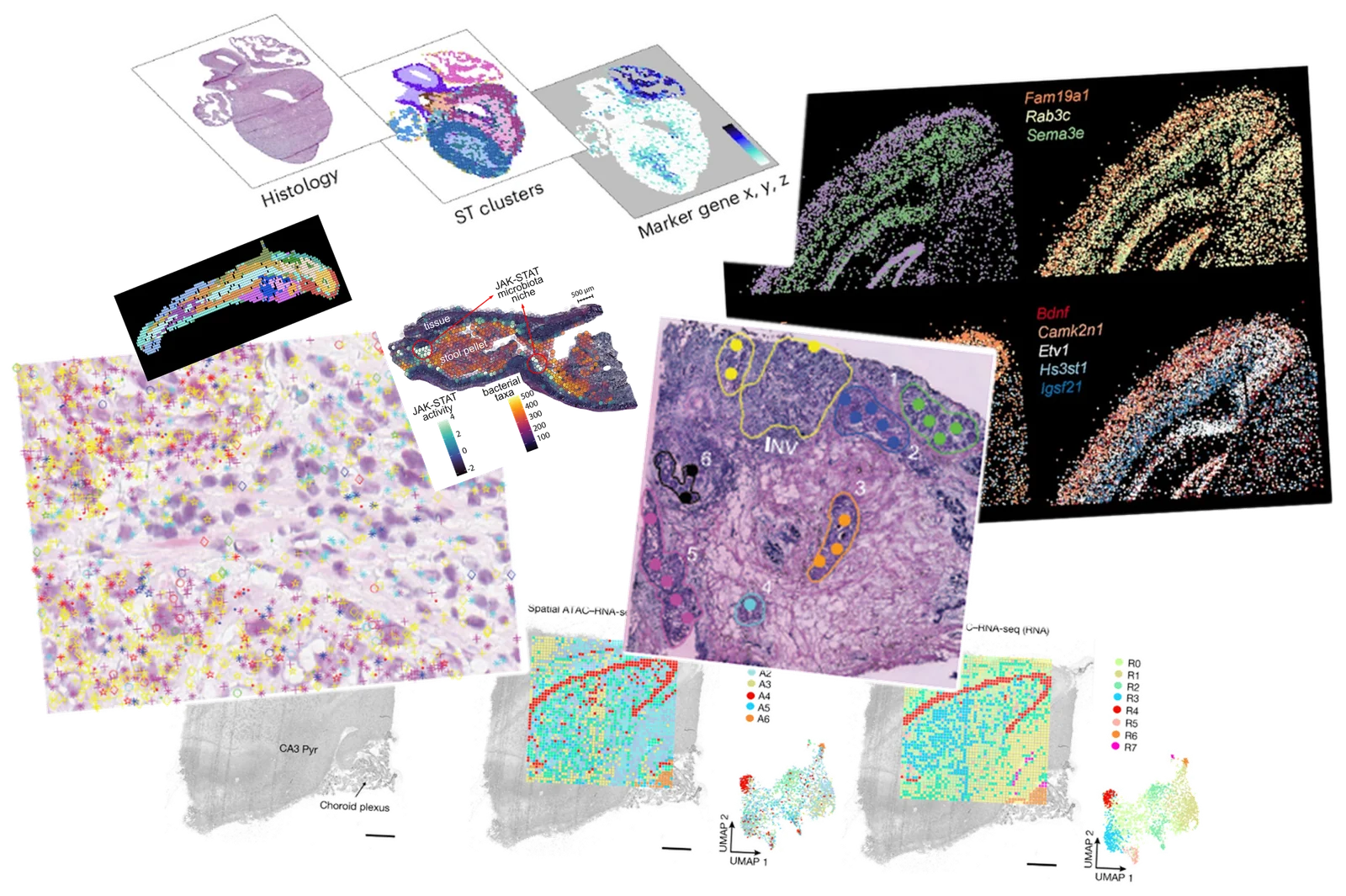
Collage of spatial biology results: histology sections, spatial transcriptomics clusters, multiplexed gene-expression maps of brain tissue, and a gut section mapping bacterial taxa against host JAK-STAT activity.

Resolve the molecules that shape living systems.

Spatial methods preserve the anatomical location of gene expression, proteins and other molecules, enabling the characterization of cells within their native tissue architecture. Members of the cluster helped establish these measurements and continue to push them toward finer resolution and more molecular layers at once.

See the methods that read molecules in place

Reconstruct tissue beyond the flat section.

A section is one plane through a structure that was never flat. Reassembling those planes, and inferring what falls between them, restores the architecture and the relationships between cells that a single slice cannot show.

Explore how spatial methods are applied

Connect measurements across development and disease.

Tissue has a history. Genetic barcoding and lineage tracing link a cell to its ancestors and its position at once, giving spatial data a temporal frame across development, disease and response to treatment.

Explore how we follow cells and their descendants
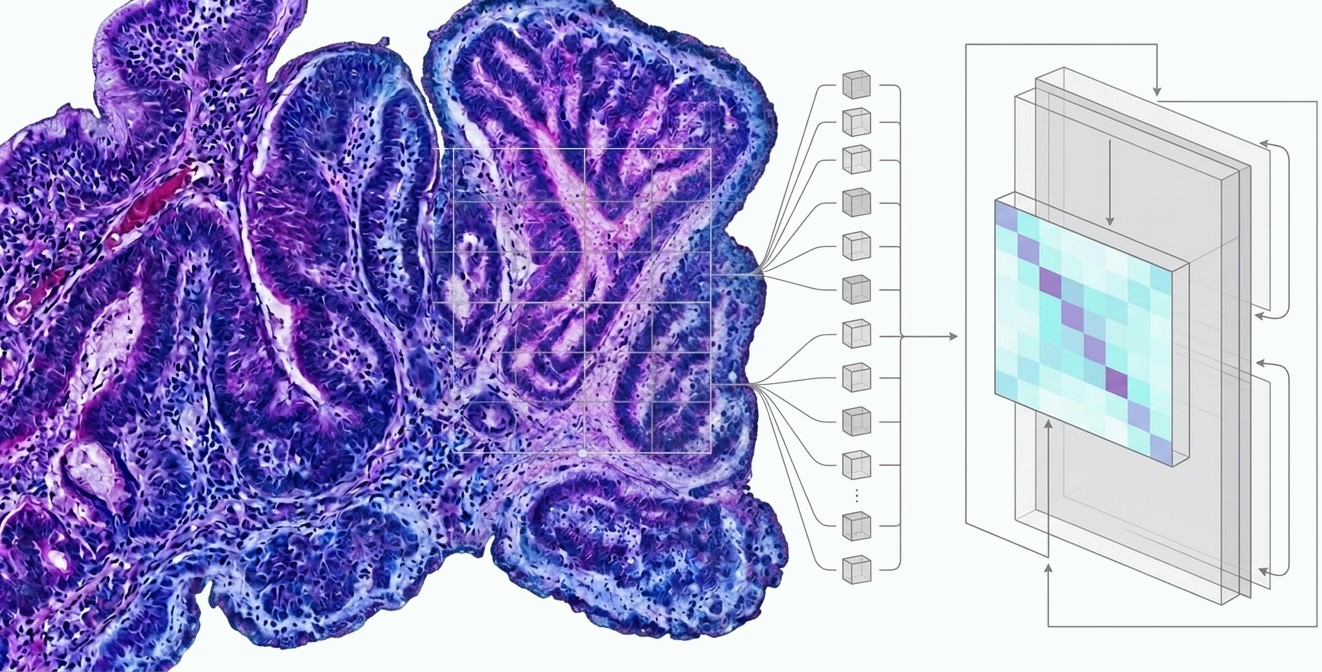
Histology section of tissue with a sampling grid, feeding through layered model panels into a heatmap and a predicted molecular profile.

Use AI to model what biology may do next.

Enough modalities, at enough scale, exceed what can be read by eye. AI is embedded across the cluster to integrate imaging with molecular profiles, predict features that were never measured, and model how tissue is organised and how it changes.

See how AI is used across the cluster

Know where the technology is needed, trusted and ready.

A new technology only matters once people can trust and use it. Social scientists and ethicists across the cluster find where spatial biology meets the greatest need, what earns the trust of patients, clinicians and the public, and which rules decide adoption, steering what we build next.

See how social science shapes the cluster

We are building the next innovation ecosystem.

This cluster fosters the next generation of academic–industry partnership — connecting researchers, industry and investors around spatial biology.

See how we work with industry

Vision

From spatial maps to predictive biology.

Sweden built the technologies that let us see how cells are organised in intact tissue. The next step is moving from increasingly detailed maps to models that explain and predict how living systems behave.

Read the vision
  • Karolinska Institutet
  • KTH Royal Institute of Technology
  • Stockholm University
  • Uppsala University
  • Linköping University
  • Chalmers University of Technology
  • Medical University of Vienna
  • Stanford University
  • Institute for Futures Studies
  • SciLifeLab